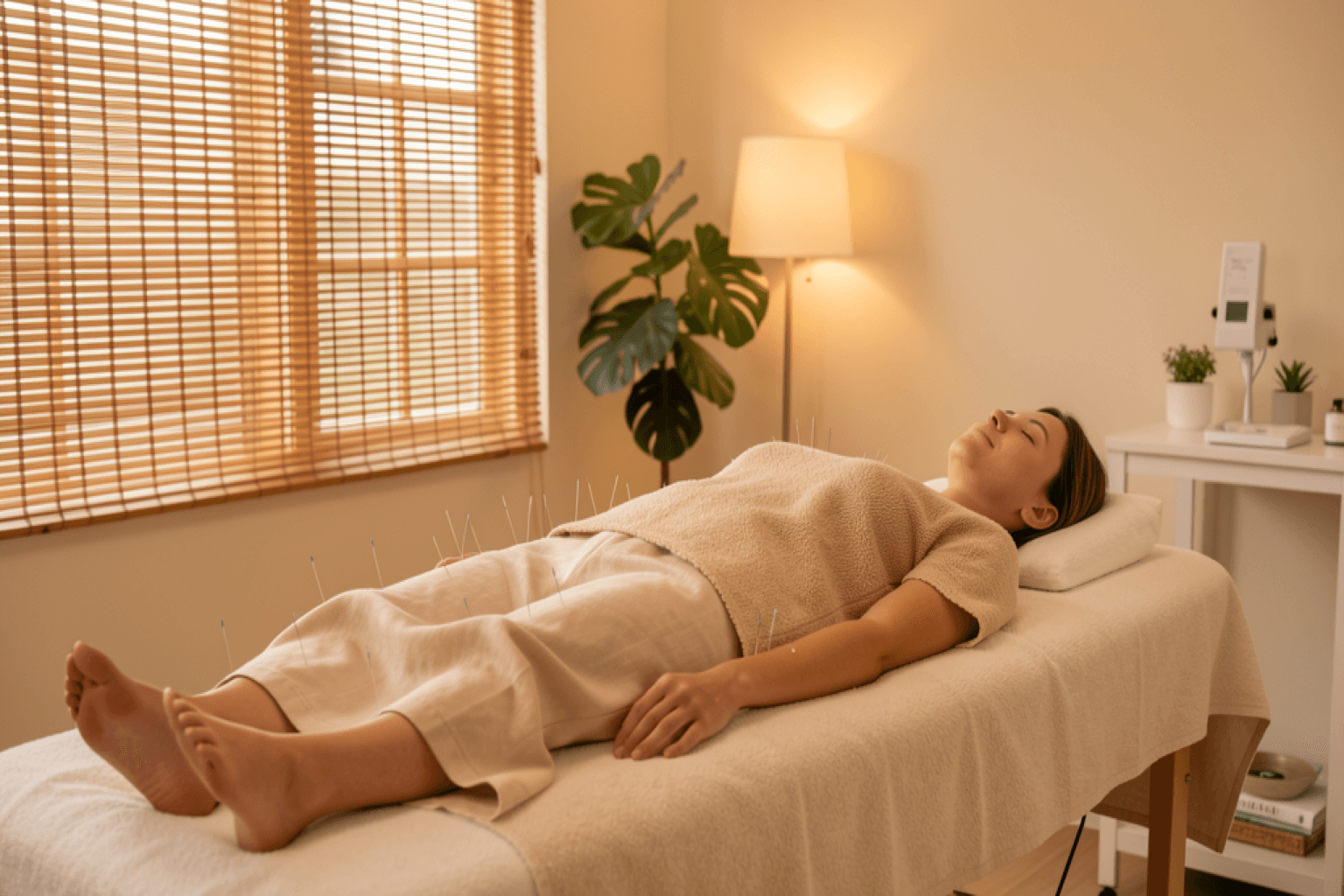
Acupuncture during chemo in Westchester: a patient guide
If you're getting cancer care at MSK Westchester or nearby in Harrison, acupuncture can help with chemo fatigue, nausea, and nerve pain as complementary care discussed with your oncology team.

Dr. Perry Levenson, DACM, L.Ac.Jul 14, 2026
Updated Oct 01, 2026

TL;DR: If you're receiving chemotherapy at Memorial Sloan Kettering Westchester or nearby in West Harrison, acupuncture can help manage fatigue, nausea, and neuropathy alongside your cancer treatment, with safety and timing discussed with your oncology team. The evidence is strong enough that major cancer centers including MSK offer acupuncture as part of supportive care. Dr. Perry Levenson's Harrison clinic is minutes from MSK Westchester and specializes in electro-acupuncture, an approach that may be considered for selected symptoms; results vary. Coordination with your oncology team is standard, and safety protocols are built into every treatment.
You're making the drive to MSK Westchester for treatment. You're following your oncologist's plan exactly. And you're still exhausted, nauseated, or dealing with nerve pain that makes every step uncomfortable.
The prescriptions help, but only so much. You've been told that fatigue, nausea, and neuropathy are normal parts of chemotherapy. And they are. But normal doesn't mean you have to just endure them.
Acupuncture is one of the few complementary therapies with enough evidence behind it that oncologists actually recommend it. MSK offers acupuncture at their main Manhattan location and across their network. But if you're getting care in Westchester, you don't have to travel to the city for it. There's another option five minutes from the hospital.
Why location matters when you're in active treatment
When you're going through chemotherapy, everything takes more effort. The thought of adding another appointment in another part of town feels like one more thing you don't have energy for.
MSK Westchester sits at 500 Westchester Avenue in West Harrison, right off I-287. Dr. Perry Levenson's practice is at 550 Mamaroneck Avenue in Harrison, less than two miles away. It's the same corridor, same exit, easy parking.
That proximity matters. You can schedule acupuncture on treatment days, before or after your oncology appointment, without driving across the county. If you're feeling rough after an infusion, you're not sitting in traffic for 45 minutes to get relief.
Can acupuncture actually help with chemotherapy side effects?
Yes, and the evidence is strong enough that oncology guidelines now recommend it.
The Society for Integrative Oncology and the American Society of Clinical Oncology (ASCO) issued joint guidelines recommending acupuncture for cancer pain and neuropathy. MSK's own integrative medicine service uses acupuncture to help manage side effects including pain, fatigue, nausea, and anxiety. The National Cancer Institute states that needle acupuncture treatment is effective for chemotherapy-induced nausea and vomiting, and participants in clinical studies reported reduced fatigue, anxiety, and depression.
This isn't fringe medicine. It's evidence-based supportive care that works alongside your chemotherapy, not instead of it. The goal is to help you feel better so you can complete treatment without your side effects derailing the plan.
Acupuncture addresses multiple side effects at once. A single session can help with fatigue, nausea, sleep, and anxiety. That matters when you're managing several symptoms and already taking multiple medications.
How does acupuncture help with chemo fatigue?
Chemo fatigue is different from normal tiredness. Rest doesn't fix it. It's driven by inflammation, metabolic disruption, and a nervous system stuck in overdrive.
Acupuncture helps by calming the sympathetic nervous system and promoting a parasympathetic shift. That's the rest-and-digest state where your body actually recovers. It also reduces inflammatory markers like IL-6 and TNF-alpha, which are directly linked to cancer-related fatigue.
A 2013 study of 302 breast cancer patients found that acupuncture reduced general fatigue scores by an average of 3.11 points on the Multidimensional Fatigue Inventory. That's a clinically meaningful change. The study also showed improvements in physical fatigue, mental fatigue, anxiety, and quality of life.
Mayo Clinic lists acupuncture as an integrative medicine option that may help relieve fatigue, noting that it should be coordinated with your healthcare team, especially if you have low blood counts.
Most patients notice some improvement within three to six sessions. If you're someone who responds to acupuncture, you'll know relatively quickly. And if you don't, you're not locked into a long treatment plan. Dr. Levenson gives you a written plan at your first visit with clear expectations so you know what progress should look like.
To learn more about how acupuncture addresses the specific mechanisms of chemo fatigue, read our detailed guide on acupuncture for chemo fatigue.
Does acupuncture help with nausea from chemotherapy?
Yes, and this is where the evidence is strongest.
Acupuncture for chemotherapy-induced nausea has been studied for decades. A 2026 systematic review of 49 randomized controlled trials involving 4,133 patients found that acupuncture significantly reduced the incidence of vomiting, vomiting severity, nausea incidence, and nausea severity compared to control groups.
The effect is most consistent for delayed nausea and vomiting, the kind that shows up days after treatment. Another 2025 meta-analysis confirmed that acupuncture significantly reduced delayed vomiting, especially when treatment lasted at least five days.
Acupuncture doesn't replace anti-nausea medications like ondansetron. It works alongside them. Many patients find that adding acupuncture means they can reduce how much medication they need, which matters when those drugs cause their own side effects like constipation and drowsiness.
The most commonly used acupuncture points for nausea are PC6 (Neiguan, on the inner wrist), ST36 (Zusanli, below the knee), and CV12 (Zhongwan, on the upper abdomen). These points have been validated across multiple studies and are part of standard protocols at major cancer centers.
What about chemotherapy-induced neuropathy?
This is where electro-acupuncture makes a real difference.
Chemotherapy-induced peripheral neuropathy (CIPN) is one of the hardest side effects to treat. The burning, tingling, and numbness in your hands and feet can persist for years after treatment ends. Duloxetine (Cymbalta) is the only FDA-approved drug for it, and many patients can't tolerate the side effects.
Acupuncture, especially electro-acupuncture, offers another option. A 2024 network meta-analysis of 33 studies found that electro-acupuncture had the most significant impact on CIPN symptoms, pain, and quality of life. Treatment needed to last at least three weeks for optimal results.
A 2025 randomized controlled trial published in Frontiers in Oncology compared real acupuncture to sham acupuncture in 68 patients with CIPN. After two weeks, the real acupuncture group showed statistically significant improvements in neuropathy scores, pain levels, and nerve conduction velocity. No serious adverse events were reported.
The ASCO-SIO guidelines state that acupuncture, reflexology, or acupressure may be recommended for patients with CIPN, though they note the evidence quality is moderate and more research is needed.
Electro-acupuncture delivers a gentle, precisely controlled electrical current through the needles. It's not painful. Most patients describe it as a mild tingling or pulsing sensation. The electrical stimulation produces more consistent nervous system activation than manual needling alone, which is why the research shows stronger results for nerve-related pain.
For a deeper look at how electro-acupuncture targets nerve damage, see our guide on electro-acupuncture for neuropathy.
Is acupuncture safe during active chemotherapy treatment?
Yes, when performed by a qualified practitioner with proper safety protocols.
A 2024 expert consensus statement published in Supportive Care in Cancer outlines the safety guidelines for acupuncture during cancer treatment. The key factors are your blood counts and coordination with your oncology team.
Acupuncture should generally be avoided if your absolute neutrophil count is below 0.5 x 10^9/L or if your platelet count is below 20 x 10^9/L. If you don't have recent blood work, acupuncture should be avoided during the nadir period of your chemotherapy cycle, when your counts are at their lowest.
Dr. Levenson is licensed in New York and Connecticut, nationally board certified, and has over 30 years of experience treating cancer patients. He uses sterile, single-use needles and follows infection control protocols for immunocompromised patients. Phone intakes cover your diagnosis, protocol, blood counts, and precautions. If acupuncture isn't safe that week, you'll hear it directly.
Serious complications are rare (less than 1 in 10,000 treatments in large safety reviews). The most common side effects are minor bruising or brief soreness. For a broader look at how acupuncture fits into cancer care, see our overview of complementary options for chemo side effects.
What does care look like at the Harrison clinic?
Dr. Levenson's practice is at 550 Mamaroneck Avenue, Suite 102 in Harrison, New York. Office hours are Tuesday and Wednesday 9 AM to 6 PM, and Friday 8 AM to 4 PM. If those days don't work with your treatment schedule, he also sees patients at his Newtown, Connecticut office on Monday and Thursday.
Your first visit starts with a comprehensive health history. Dr. Levenson will ask about your cancer diagnosis, your treatment plan, your current symptoms, your medications, and any other health conditions. He'll explain whether he thinks acupuncture can help and give you a written treatment plan with clear milestones.
If you decide to move forward, treatment often begins the same day. Most sessions run 20 to 30 minutes. For electro-acupuncture, small clips connect the needles to a device that delivers a mild electrical current. You'll rest on a padded table while the treatment works.
How many sessions you need depends on what you're treating. Recent, acute symptoms like post-infusion nausea may improve within a few sessions. Chronic issues like long-standing neuropathy or persistent fatigue usually take longer. Six to ten sessions is a common starting point.
Dr. Levenson coordinates with your oncology team when needed. If you're getting care at MSK Westchester, White Plains Hospital, or another nearby cancer center, he can communicate directly with your doctors about timing, precautions, and progress.
Harrison, NY: 550 Mamaroneck Avenue, Suite 102 | Tuesday & Wednesday 9 AM - 6 PM, Friday 8 AM - 4 PM Newtown, CT: 141 Mount Pleasant Rd, Unit 3 | Monday & Thursday 8 AM - 8 PM Phone: (914) 584-6995 Book online: whole-healthy-family.acubliss.app
For more information about what acupuncture can address during cancer treatment, visit our acupuncture for cancer support page.
Frequently asked questions
Can I get acupuncture while on chemotherapy?
Yes, in most cases. The main safety considerations are your white blood cell count and platelet count. If your counts are within safe ranges (neutrophils above 0.5 x 10^9/L, platelets above 20 x 10^9/L), acupuncture is generally safe. Dr. Levenson reviews your recent blood work and coordinates with your oncology team when needed. If counts are unknown, he may recommend scheduling around the nadir period of your chemotherapy cycle when blood counts are at their lowest.
How close is Whole Healthy Family to MSK Westchester?
The Harrison office is less than two miles from MSK Westchester. MSK is at 500 Westchester Avenue in West Harrison, and Whole Healthy Family is at 550 Mamaroneck Avenue in Harrison. Same corridor, same exit off I-287, about a five-minute drive. You can schedule acupuncture on treatment days without adding significant travel time.
Does acupuncture interfere with cancer treatment?
No. Acupuncture is a complementary therapy, meaning it works alongside chemotherapy, not instead of it. It does not reduce the effectiveness of chemotherapy or interfere with how the drugs work. In fact, major cancer centers including MSK, MD Anderson, and Mayo Clinic offer acupuncture as part of standard supportive care specifically because it can help patients complete treatment by managing side effects that might otherwise cause delays or dose reductions.
How soon before or after infusion should I schedule?
Timing varies by person and by treatment protocol. Some patients prefer acupuncture the day before or the morning of infusion to reduce anticipatory nausea and anxiety. Others schedule it one to three days after infusion to address delayed nausea, fatigue, or other post-treatment symptoms. Dr. Levenson will discuss timing during your intake based on your specific chemotherapy regimen and which symptoms are most disruptive. Many patients find that weekly or twice-weekly sessions work best during active treatment.
Does acupuncture help with neuropathy after chemo ends?
Yes. Many patients develop neuropathy during treatment and continue experiencing symptoms for months or years after chemotherapy ends. Research shows acupuncture can help even when neuropathy is chronic. A 2024 network meta-analysis found that electro-acupuncture improved symptoms, pain, and quality of life in patients with established CIPN, though it took at least three weeks of treatment to see meaningful change. If you're dealing with lingering nerve pain, numbness, or tingling, acupuncture is worth trying even if treatment ended months or years ago.
Disclaimer: This article is for informational purposes and does not constitute medical advice. Always consult with your oncologist before starting any complementary therapy during cancer treatment.
Whole Healthy Family is an independent practice and is not affiliated with Memorial Sloan Kettering Cancer Center. Acupuncture is complementary symptom support and does not replace your oncology care. Review treatment timing and safety with your oncology team.