When pain persists
Persistent pain can involve changes in how the nervous system processes signals, as well as ongoing injury or illness. An individual assessment helps decide whether acupuncture fits alongside physical therapy, exercise and medical care.
Patients from Fairfield County can visit our Newtown office; Westchester patients can visit Harrison.
Read about lower back pain and electro-acupuncture.
Acupuncture for chronic pain

The injury healed. The pain didn't get the message.
Chronic pain isn't acute pain that just lasted longer. It's what the body does after the injury has already healed.
The pain was supposed to get better. The injury healed, or the diagnosis was managed, or the surgery was done. And still, months later, it's there. Sometimes in the same place. Sometimes somewhere new. Sometimes worse than before.
That's not weakness, or bad luck, or something you're imagining. It's what chronic pain does.
You've probably already done what you were supposed to do. Physical therapy. Medications. Imaging. Maybe injections or specialist referrals. And you're still here, still hurting. That's not a sign nothing will work. It's a sign the approach hasn't matched where the problem lives.
Chronic pain persists because the nervous system itself has changed. This is the part most patients haven't been told.
Acute pain is a signal: something is wrong, the body responds, healing happens, the signal quiets. Chronic pain is different. Prolonged pain sensitizes the neural pathways that carry pain signals, making them fire more easily even after the tissue has healed. The body adapted to protect you, learning pain in a way that didn't unlearn itself.
This process, called central sensitization, is well-documented in pain research and explains patterns that confuse many patients: why pain spreads, why it migrates, why it flares without an obvious trigger, why nothing on the imaging explains what you're feeling.
Understanding this matters. It points to where effective treatment has to work. Not at the site of symptoms. At the nervous system level where the pattern is held.
How acupuncture treats chronic pain
It's not placebo, and it's not a relaxation response. Here's what the research actually shows.
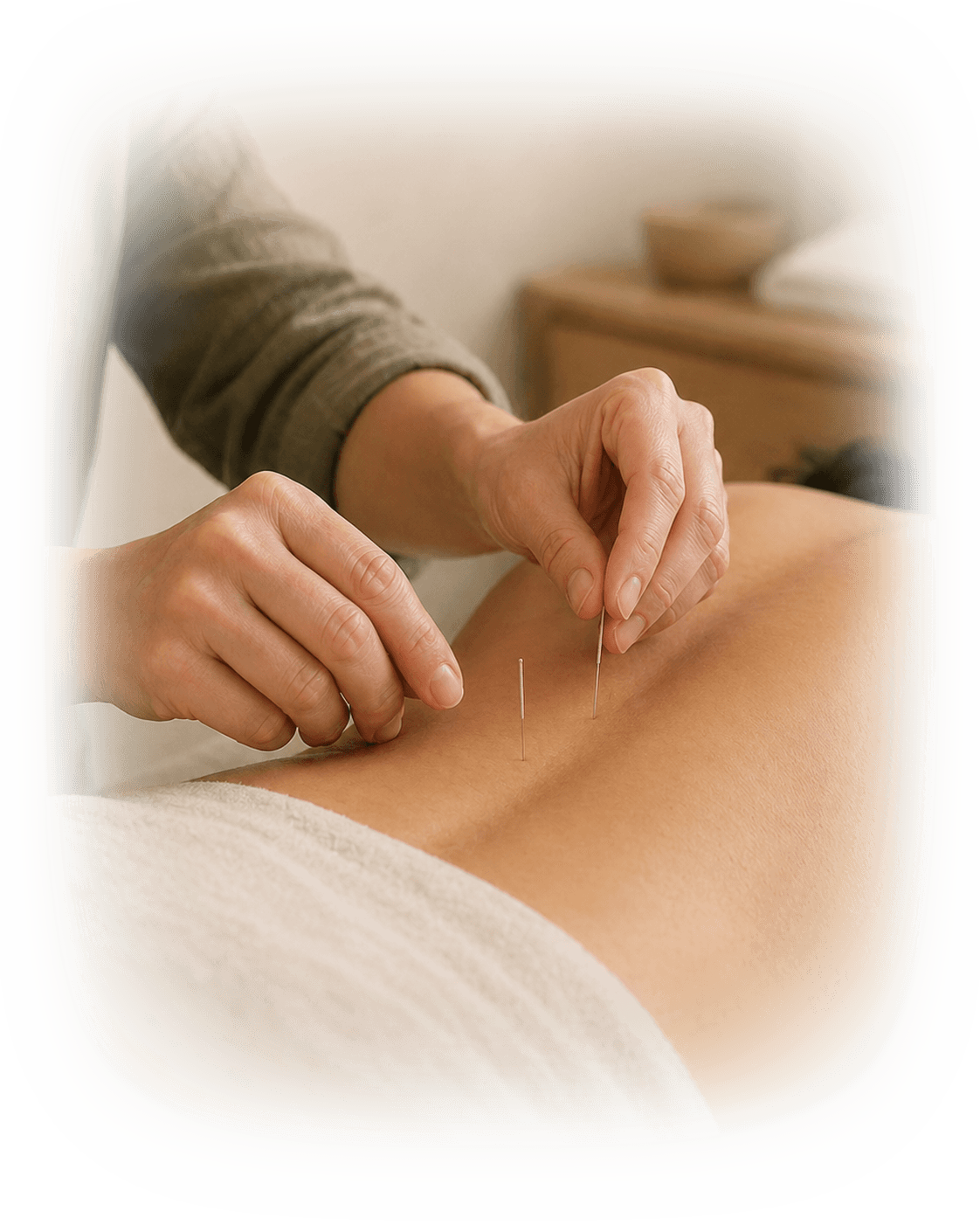
Chronic pain lives in the nervous system, and that's where acupuncture works. Fine needles at specific body points stimulate descending pain-inhibitory pathways, reduce neuroinflammation, and prompt the release of the body's own pain-modulating compounds.
A landmark meta-analysis in The Journal of Pain of 20,827 patients across 39 randomized trials found acupuncture more effective than sham and no-treatment controls for chronic musculoskeletal pain, osteoarthritis, chronic headache, and shoulder pain, with effects holding at 12 months. The authors concluded the relief "cannot be explained solely in terms of placebo effects."
For chronic low back pain, the American College of Physicians recommends acupuncture as a first-line nonpharmacologic treatment, ahead of medications. The National Center for Complementary and Integrative Health extends the evidence to knee osteoarthritis, migraine, and tension headache.
None of this replaces medical care. It means acupuncture has a real role in chronic pain treatment, especially for patients whose conventional approaches haven't reached the nervous system pattern behind the symptom.
Chronic pain isn't one thing
These are the chronic pain conditions Dr. Levenson treats most often, across both common and treatment-resistant cases.
Chronic back pain
The lumbar ache that wakes you up and stiffens as the day goes on.
Neck & shoulder pain
The tension that sits behind your shoulder blade or travels up into your skull.
Joint pain & osteoarthritis
Knees, hips, and shoulders that ache with movement or stiffen after sitting.
Migraines & chronic headaches
Migraines, tension headaches, cervicogenic headaches, the kind that shape your week.
Neuropathy & nerve pain
The burning, tingling, or numbness of peripheral, diabetic, and post-chemotherapy neuropathy.
Fibromyalgia
The whole-body ache that shifts and doesn't track to a single cause.
Sports injuries & strains
Rotator cuff, plantar fasciitis, tennis elbow, and the overuse patterns that linger past rehab.
Pain that migrates
Pain that moves, spreads, or flares without an obvious trigger.
Electro-acupuncture, for pain the rest of medicine missed

Dr. Levenson uses advanced electro-acupuncture, a method that applies a precisely calibrated electrical current through acupuncture needles to achieve deeper and more consistent stimulation of the nervous system than traditional needling alone.
It's an approach he has developed over nearly 25 years of clinical practice, producing significant therapeutic effect through minimal intervention.
Beyond the technique itself, a few things shape every session:
- Four-needle protocol, refined across decades of precise point selection
- Sessions gentle enough that many patients fall asleep on the table
- Treatment aimed at the nervous system pattern, not just the site of the symptom
- Space for the emotional weight of living with pain, not only the physical ache
This is not the standard acupuncture available at most practices in the area. The depth of training behind it is rare locally, and it's one of the primary reasons patients travel past other providers to come here.

How electro-acupuncture compares to other chronic pain treatments
Most patients exploring acupuncture for chronic pain have already tried physical therapy, medication, or injections. Here's how the approaches differ.
| Compare treatments | Electro-acupuncture | Physical therapy | Prescription pain medication | Corticosteroid injections |
|---|---|---|---|---|
| Targets the nervous system pattern | Partially | Symptom suppression only | Reduces local inflammation | |
| Typical timeframe for improvement | 4–6 sessions | 8–12 sessions | Ongoing while dosing | 1–3 injections, short-term relief |
| Side effects | Minimal (occasional bruising) | Soreness, fatigue | Varies; dependency risk with opioids | Cartilage loss with repeated use |
| Effective for neuropathy | Emerging evidence | Limited | First-line (gabapentinoids) | |
| Effective for migrating or widespread pain | Limited (site-specific) | Requires continuous dosing | ||
| Addresses the emotional weight of living with pain | Rarely |
| Targets the nervous system pattern | |
|---|---|
| Typical timeframe for improvement | 4–6 sessions |
| Side effects | Minimal (occasional bruising) |
| Effective for neuropathy | Emerging evidence |
| Effective for migrating or widespread pain | |
| Addresses the emotional weight of living with pain |
| Targets the nervous system pattern | Partially |
|---|---|
| Typical timeframe for improvement | 8–12 sessions |
| Side effects | Soreness, fatigue |
| Effective for neuropathy | Limited |
| Effective for migrating or widespread pain | Limited (site-specific) |
| Addresses the emotional weight of living with pain | Rarely |
| Targets the nervous system pattern | Symptom suppression only |
|---|---|
| Typical timeframe for improvement | Ongoing while dosing |
| Side effects | Varies; dependency risk with opioids |
| Effective for neuropathy | First-line (gabapentinoids) |
| Effective for migrating or widespread pain | Requires continuous dosing |
| Addresses the emotional weight of living with pain |
| Targets the nervous system pattern | Reduces local inflammation |
|---|---|
| Typical timeframe for improvement | 1–3 injections, short-term relief |
| Side effects | Cartilage loss with repeated use |
| Effective for neuropathy | |
| Effective for migrating or widespread pain | |
| Addresses the emotional weight of living with pain |
| Compare treatments | Electro-acupuncture | Physical therapy | Prescription pain medication |
|---|---|---|---|
| Targets the nervous system pattern | Partially | Symptom suppression only | |
| Typical timeframe for improvement | 4–6 sessions | 8–12 sessions | Ongoing while dosing |
| Side effects | Minimal (occasional bruising) | Soreness, fatigue | Varies; dependency risk with opioids |
| Effective for neuropathy | Emerging evidence | Limited | First-line (gabapentinoids) |
| Effective for migrating or widespread pain | Limited (site-specific) | Requires continuous dosing | |
| Addresses the emotional weight of living with pain | Rarely |
| Targets the nervous system pattern | |
|---|---|
| Typical timeframe for improvement | 4–6 sessions |
| Side effects | Minimal (occasional bruising) |
| Effective for neuropathy | Emerging evidence |
| Effective for migrating or widespread pain | |
| Addresses the emotional weight of living with pain |
| Targets the nervous system pattern | Partially |
|---|---|
| Typical timeframe for improvement | 8–12 sessions |
| Side effects | Soreness, fatigue |
| Effective for neuropathy | Limited |
| Effective for migrating or widespread pain | Limited (site-specific) |
| Addresses the emotional weight of living with pain | Rarely |
| Targets the nervous system pattern | Symptom suppression only |
|---|---|
| Typical timeframe for improvement | Ongoing while dosing |
| Side effects | Varies; dependency risk with opioids |
| Effective for neuropathy | First-line (gabapentinoids) |
| Effective for migrating or widespread pain | Requires continuous dosing |
| Addresses the emotional weight of living with pain |
From first call to written treatment plan
Most patients who find this page have already spent years in treatment. These four steps are about finding out whether this approach can reach what the others haven't.
Struggled with neck pain & neuropathy for 20 years. Since working with Perry, my shoulder pain has been manageable and my neuropathy has improved. I can feel circulation again. His compassion and care is far beyond any professional health care member I have ever met.
Angelo Centrone
20 years of chronic pain and neuropathy
Frequently asked questions
The questions patients most often ask before starting acupuncture for chronic pain.
Chronic pain often persists because the nervous system itself has changed, a process called central sensitization. Prolonged pain sensitizes the neural pathways that carry pain signals, making them more reactive and easier to trigger, even after the original tissue damage has resolved.
That's why approaches aimed only at the injury site often can't break the cycle. Acupuncture works at the nervous system level, which is where the pattern actually lives.
Electro-acupuncture applies a gentle, precisely calibrated electrical current through acupuncture needles, producing deeper and more consistent nervous system stimulation than traditional needling alone. For chronic pain, which involves sensitized pain pathways rather than just local tissue damage, that depth is often what makes the difference.
Dr. Levenson uses this method specifically because of its documented effectiveness for persistent and treatment-resistant pain.
Most patients with chronic pain notice meaningful improvement within 4 to 6 sessions, though some respond sooner. Conditions that have been present for years, including neuropathy, fibromyalgia, and migrating pain, typically take longer because the nervous system patterns behind them are more entrenched.
At your first visit, Dr. Levenson will give you a written treatment plan with specific milestones and an honest timeline based on your condition and history.
Yes. This is one of the more common presentations in this practice. Pain that doesn't show clearly on imaging, pain without a confirmed structural cause, and pain that seems to move or shift are all conditions where acupuncture has a clinical track record.
The absence of a structural explanation doesn't mean the pain isn't real, or that it can't be addressed.
Migrating pain is a specific area Dr. Levenson has treated extensively over nearly 25 years of practice. Pain that shifts location, spreads, or has no consistent pattern often reflects a broadly sensitized nervous system rather than a single structural issue.
Electro-acupuncture addresses this at the nervous system level, which is why it can reach pain that site-specific treatments haven't.
Most patients notice some degree of relief or reduction in tension within 24 to 48 hours of their first session. Some notice it immediately; others feel it more gradually over the following day.
A small number of patients experience mild soreness or fatigue after the first treatment as the body responds to the stimulation. Dr. Levenson will tell you specifically what to watch for after your session.
Whole Healthy Family is a private-pay practice and does not bill insurance directly. Many patients are able to submit for partial reimbursement through their insurance's out-of-network benefits or health savings accounts.
We can provide documentation to support that process. Pricing details are available when you call.
If chronic pain has been limiting your life, this is worth a conversation
Dr. Levenson has spent nearly 25 years with patients who came to him because physical therapy, medications, and specialists hadn't reached their pain. A first visit will tell you honestly whether this approach can. We'll start with a real conversation. No obligation, no pressure.
Harrison New York
550 Mamaroneck Ave, Suite 102, Harrison, NY 10528
Tuesday & Wednesday 9 AM - 6 PM
Friday 8 AM - 4 PM
Newtown Connecticut
141 Mount Pleasant Rd, Unit 3, Newtown, CT 06470
Monday & Thursday 8 AM – 8 PM