Nervous about needles? What to actually expect at your first acupuncture visit
Nervous about acupuncture needles? Here's a warm walkthrough of your first visit at Whole Healthy Family, from the intake conversation to the needles to how you'll feel when you leave.

Dr. Perry Levenson, DACM, L.Ac.Apr 20, 2026
Updated Oct 01, 2026
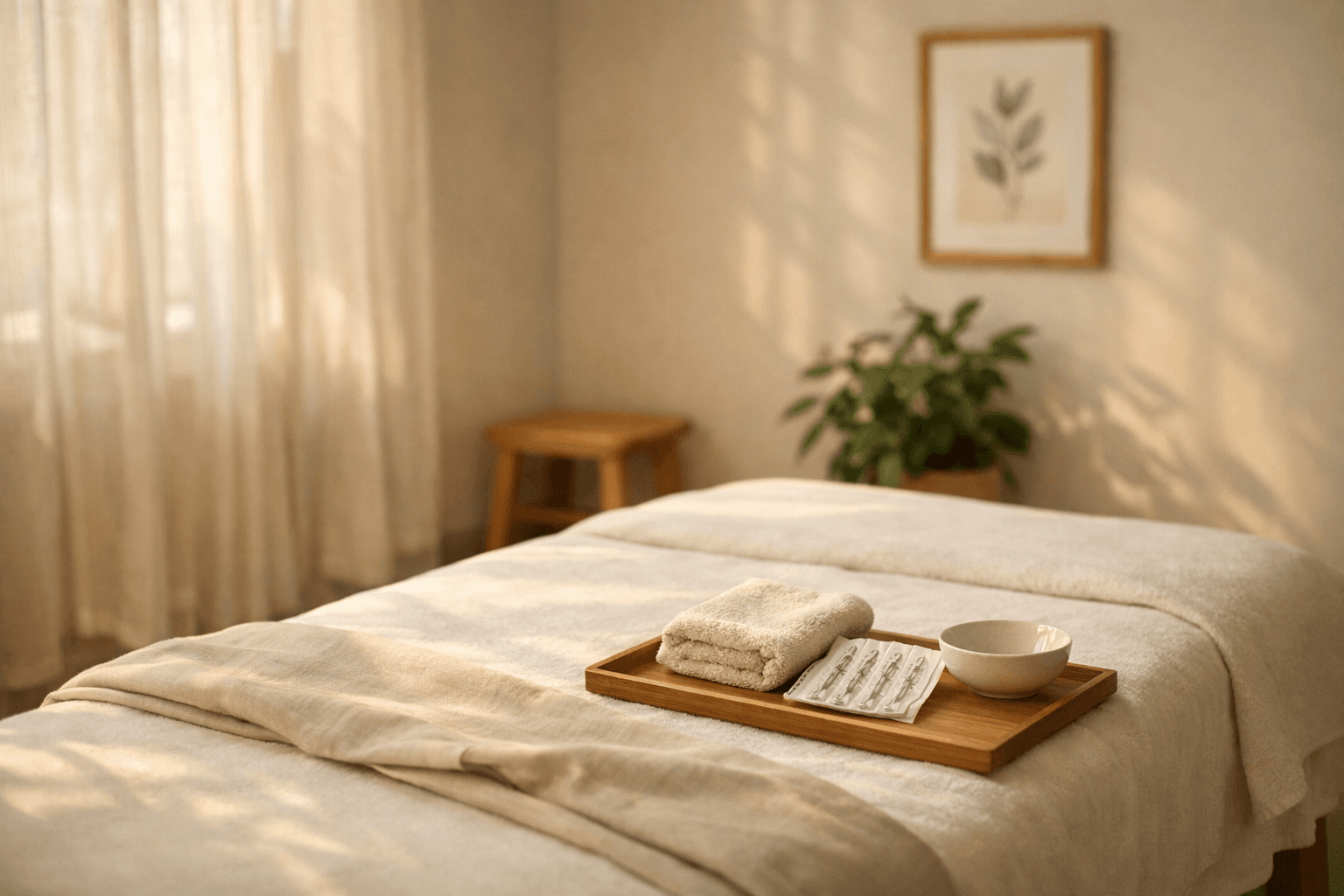
Overview: Your first acupuncture visit at Whole Healthy Family runs about an hour. Most of that time isn't needles. It's Dr. Perry Levenson getting to know your history, your goals, and how your body feels right now. The needles are hair-thin and usually painless. For most patients, treatment happens at that same first visit, and you'll leave with a written plan.
If you've been putting off your first acupuncture visit because of the needles, you're in good company. Most people who walk into our office the first time say some version of the same thing: "I'm nervous."
That's fair. Needles aren't something any of us grow up loving. But here's what's worth knowing before you book. Acupuncture needles aren't the needles you're picturing. They're not the ones from blood draws, flu shots, or IV lines. They're thinner than a strand of hair, and most patients barely feel them go in.
This post walks you through exactly what happens when you come in. The conversation that starts things off. The tongue and pulse check. Where the needles go, how long they stay, and what you'll feel while they're in. By the end, you should have a clear picture of your first appointment, minus the worst-case stories you've been told.
Does acupuncture actually hurt?
For most people, no. Acupuncture needles are far thinner than the ones used for shots or blood draws, and they're designed to slide through tissue instead of cutting it. You might feel a light tap, a tingle, or a dull ache. Sharp pain isn't normal, and you can always speak up if something feels off.
The needles used in acupuncture are solid and hair-thin, nothing like a hypodermic. In one large patient survey, only about 3.75% of people reported pain at the needle site.
What you might feel once a needle lands is sometimes called deqi. It's a heavy, warm, or tingling sensation around the point. Practitioners see it as a sign the point is active. If you feel a sharp or electric jolt instead, mention it so your practitioner can adjust the angle or depth.
How long is your first acupuncture appointment?
Plan for about an hour. Most of that time goes into the intake conversation, not the needles. Treatment happens at that same visit for most new patients. Follow-up sessions run 45 to 60 minutes once Dr. Levenson knows your history.
First visits are longer on purpose. A thorough intake is how a practitioner builds a plan that fits you, not a generic template. Good acupuncture isn't one-size-fits-all.
To build something that actually matches your body, Dr. Levenson needs the full picture. Your main concern. How long it's been going on. What you've already tried. How you sleep and eat. How stress shows up for you. Rushing that conversation is how you end up with treatment that doesn't land, so we don't rush it.
What happens during the intake?
Dr. Levenson will ask about your main concern, your medical history, your sleep, digestion, energy, and stress. He'll also look at your tongue and feel the pulse at both wrists. It feels more like a conversation than a medical exam, and it shapes the points chosen for your treatment.
The conversation usually starts before you even walk in. First contact at Whole Healthy Family is a real phone call or message, not an online intake queue. Before anything is scheduled, Dr. Levenson wants to hear what you're dealing with, how long it's been going on, and what you've already tried. That exchange shapes the first visit before you arrive.
The tongue and pulse aren't folklore. They're diagnostic tools rooted in traditional Chinese medicine that help a practitioner read what's happening under the surface. Color, coating, and shape on the tongue. Rhythm, strength, and quality of the pulse at different positions. Together they offer clues a symptom list alone can miss.
Most people who find us are dealing with something that's been going on for a while. If you're coming in for chronic pain that won't quit, long-standing sleep trouble, or anxiety that's quietly reshaped your days, the intake is where the full story comes out. That's what shapes which points Dr. Levenson chooses and how he plans the course of care.
The treatment itself, step by step
Once the intake is done, you'll settle onto a padded treatment table, fully clothed or partially covered under a sheet, depending on which points are being used. The room is quiet. Lights are low. Music is soft or off, your preference.
Dr. Levenson chooses points based on what came up in the intake. His approach leans toward fewer, carefully chosen points rather than a high needle count. A refined four-needle protocol, developed over nearly 25 years of practice, produces significant effect through minimal intervention. Most points land on the arms, legs, hands, feet, belly, back, or head. The insertions are quick.
Once the needles are in, they usually stay in place for about 20 to 30 minutes. You rest. Many patients fall asleep on the table, even ones who walked in braced against the idea of needles. Dr. Levenson checks in during that window, removes the needles at the end, and that's the session. For nerve-related pain, chemotherapy-induced neuropathy, or other conditions that benefit from deeper nervous system stimulation, the treatment may include electro-acupuncture, a gentle electrical current run through the needles.
How you'll feel during and after
During the rest period, most people feel a wave of calm settle in. Heart rate slows. Shoulders drop. Some feel a pleasant heaviness, others a floaty lightness. Emotions sometimes surface unexpectedly. That's normal, and it passes.
After the session, plan for a gentle rest of your day if you can. A large meta-analysis of acupuncture adverse events found that mild effects like tiredness, light bruising, or brief lightheadedness show up in roughly 9% of treatment series. They usually pass within a day.
Many patients sleep deeply that night. Some feel the real shift the next morning. If you came in with pain, you might notice a change right away or over the next few sessions. Acupuncture tends to build on itself rather than flip a switch.
Before you leave, you'll have a written treatment plan: recommended session frequency, what you're working toward, and how Dr. Levenson will know it's working. He reassesses out loud at regular intervals. If this approach isn't reaching your issue, he'll tell you directly, and you won't be pressured to keep going.
Is acupuncture safe?
Yes, when it's performed by a licensed practitioner using sterile, single-use needles. Serious complications are rare. The most common side effects are mild: brief soreness, small bruises, or a feeling of tiredness. Ask about credentials before you book anywhere.
The National Center for Complementary and Integrative Health considers acupuncture safe under those conditions, and a broad systematic review in Scientific Reports concluded serious adverse events are uncommon in skilled hands.
Every needle used in our practice is sterile, single-use, and disposed of immediately after. Dr. Levenson is a doctor of acupuncture and Chinese medicine, nationally board certified, and licensed in Connecticut and New York. If you're booking somewhere else, ask for equivalent credentials before your first visit.
How should you prepare for your first visit?
Eat a light meal an hour or two before. Wear loose, comfortable clothes that can roll up above the knees and elbows. Skip heavy caffeine and alcohol that day. Bring a list of any medications and supplements you take, and arrive a few minutes early so you're not rushed.
Acupuncture on a completely empty stomach can leave some people lightheaded, so don't skip food. Loose clothing makes it easier to access common points without fully undressing. Heavy caffeine in the hour before can pull against the calming effect the treatment is trying to build.
Beyond that, the best preparation is mental. Come in with your questions ready. Anything you've read, anything you're nervous about, anything your gut tells you to ask. Your first visit is as much your interview of the practitioner as the other way around.
The bottom line
Most people leave their first acupuncture visit wondering what they were so worried about. The room was quiet. The needles weren't what they expected. Their shoulders came down a few inches, and for the first time in a while, their nervous system got a real break.
If chronic pain, anxiety, sleep trouble, or something else has you considering this, the first visit is where you find out whether it's a fit. You'll leave with a clearer sense of what acupuncture can do for your specific situation, and whether Dr. Levenson's approach feels right for you.
Ready to stop wondering and start the conversation? Book your first appointment at Whole Healthy Family and let's see what your body has been waiting for.
Frequently asked questions
How many acupuncture sessions will I need to feel a difference?
It depends on what you're treating. Acute issues sometimes shift in 1 to 3 sessions. For chronic pain, evidence-based reviews point to 6 to 15 sessions across a treatment course for meaningful change. Dr. Levenson will give you a realistic estimate after your first visit, once he's seen how your body responds.
Can I drive myself home after acupuncture?
Almost always, yes. Most people feel relaxed but fully alert after a session. A small percentage feel briefly lightheaded, especially after an intense treatment on an empty stomach. If that ever happens, you can rest in our office until it passes before you get behind the wheel.
Will my insurance cover acupuncture?
Whole Healthy Family is a private-pay practice and doesn't bill insurance directly. Many patients submit claims for partial reimbursement through their insurance's out-of-network benefits or health savings accounts. We can provide documentation to support that process, and pricing details are available when you call.
How deep do the needles actually go?
It depends on the point. Some points, like those on the fingers or face, use needles that only go a few millimeters deep. Others, on the larger muscles of the back or thighs, go deeper. Your practitioner adjusts depth based on your body, your muscle tone, and the point itself. You shouldn't feel sharp pain in any case.
What if I'm really scared of needles?
Tell your practitioner right at the start. There are gentler ways to begin: fewer needles, shallower insertions, or even non-needle techniques for a first visit. Most patients who came in with real needle fear describe their first full session as much easier than they'd braced for. We'll go at your pace.